Why winter cycling feels so much colder than walking — the wind chill math
At 23°F (-5°C), riding at 12 mph (20 km/h) feels like 11°F (-11.6°C). We ran the official wind chill formula at cycling speeds and lay out what to protect first.
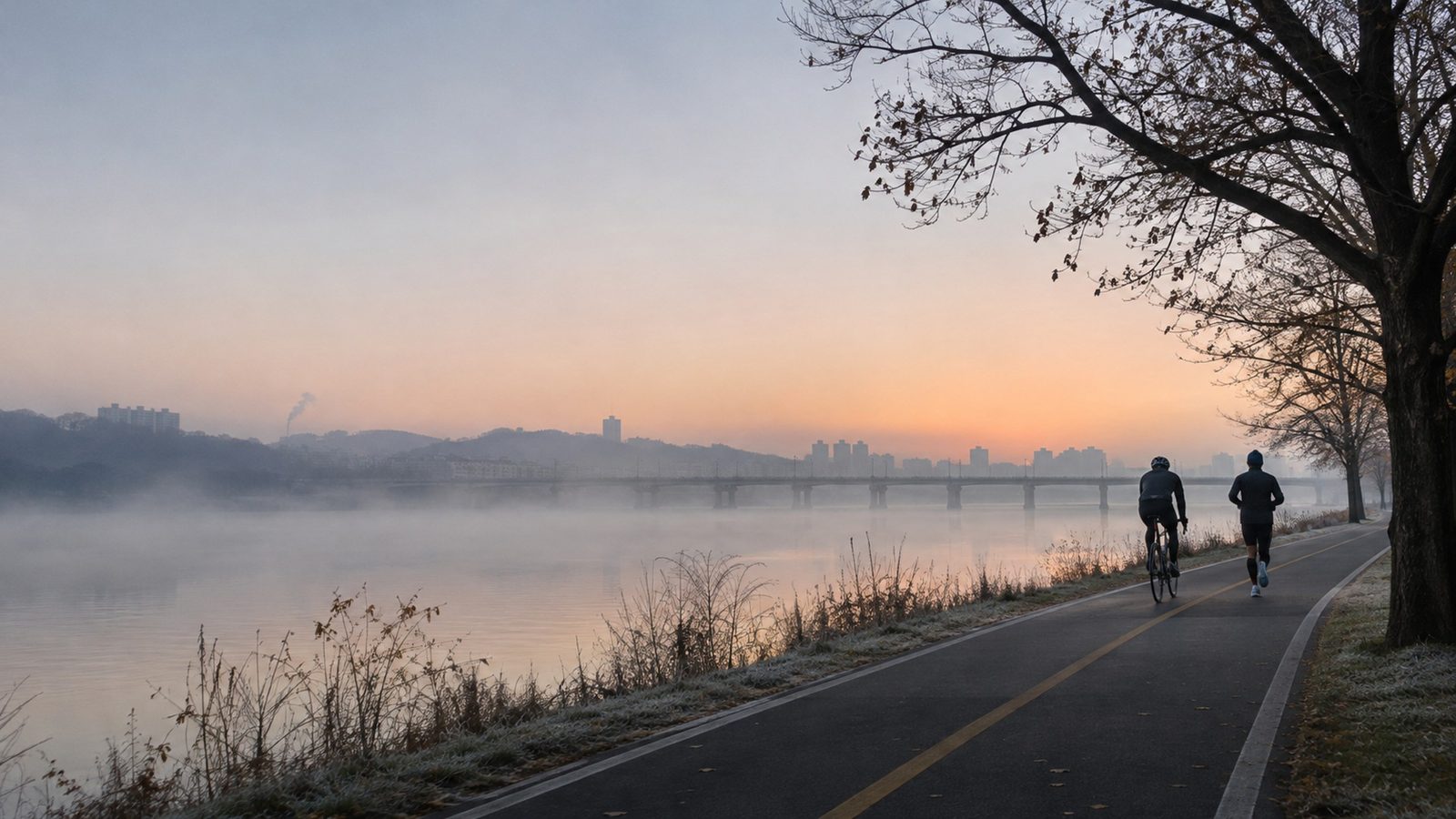
Weather that is fine for a walk can make your fingertips ache within minutes on a bike. The reason is simple: on a bike you are always riding into a wind equal to your own speed. Even on a still day, riding at 12 mph puts you in a 12 mph wind.
The wind chill formula
Korea's weather agency (KMA) uses the same metric formula as the US National Weather Service: wind chill = 13.12 + 0.6215×T − 11.37×V^0.16 + 0.3965×T×V^0.16, where T is air temperature in °C and V is wind speed in km/h. It applies at 10°C (50°F) and below.
For cycling, use your speed plus any headwind as V. On a calm day at 20 km/h, V = 20.
| Air temp | 12 mph (20 km/h) | 19 mph (30 km/h) |
|---|---|---|
| 41°F (5°C) | ≈34°F (1.1°C) | ≈32°F (0.1°C) |
| 32°F (0°C) | ≈23°F (-5.2°C) | ≈20°F (-6.5°C) |
| 23°F (-5°C) | ≈11°F (-11.6°C) | ≈9°F (-13.0°C) |
These values come straight from the formula. A 23°F commute at 12 mph feels like about 11°F; push to 19 mph and it drops a few more degrees.
What cools first
Your torso makes heat while you pedal. Your hands barely move on the bars and sit out front in the full wind, so fingers usually go numb first, then ears and face, then toes on the pedals.
Prepare in that order. Protecting hands, ears and feet does more than adding bulk to your core.
Block the front
On a bike the wind comes almost entirely from the front. Clothing with a windproof front and a breathable back lets sweat out while stopping cold air. For hands, a cover that wraps the handlebar blocks wind better than one thick glove; for feet, covers over the toe and top of the shoe help.
Slowing down helps
As the table shows, lower speed means a higher wind chill. On very cold days, riding a little slower makes a real difference to your fingers — and on early mornings when the road may be icy, it is safer too.
A five-minute pre-ride check
Put your gloves on indoors so your hands leave warm; cold hands rarely warm up once you are riding. A neck gaiter that covers your ears, a windproof outer layer and shoe covers will get you through most winter commutes.